
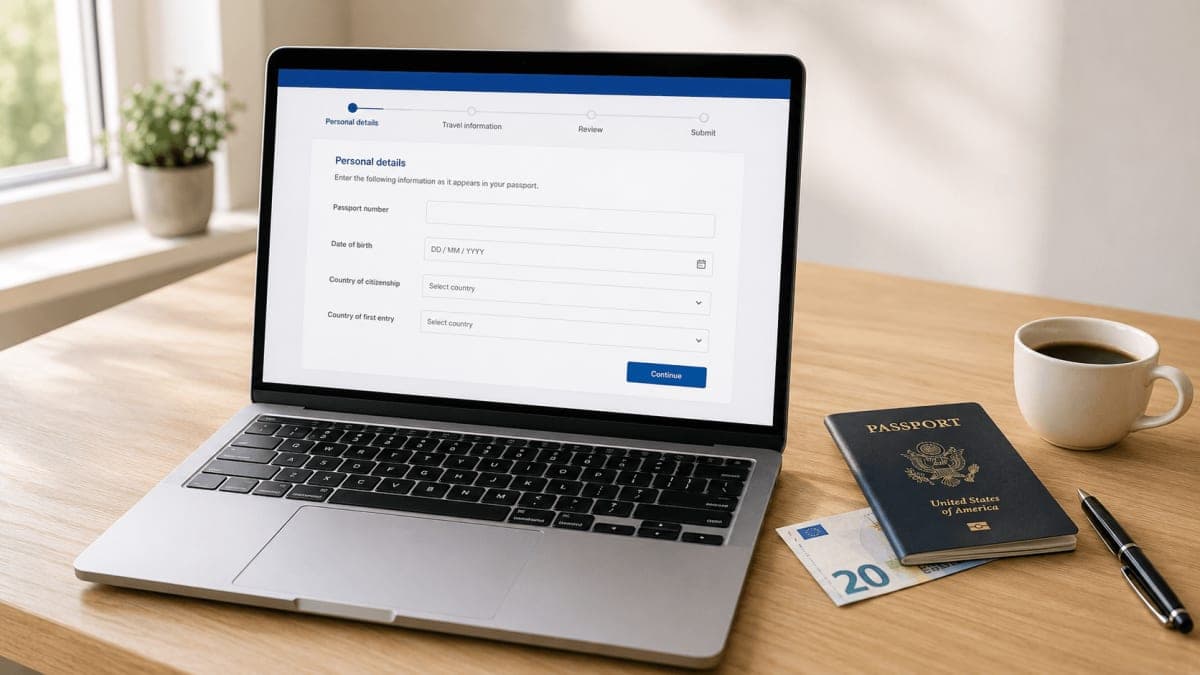
Key Takeaways
- ETIAS is not in operation. The EU's official site says no applications are being collected and gives no start date. The previous "last quarter of 2026" target has been removed.
- You do not need one for a trip this autumn or Christmas, and you could not get one if you tried.
- Any site offering to process an ETIAS application today is selling something that does not exist. No application can be submitted anywhere.
- The fee will be EUR 20 when it launches, free for under-18s and over-70s, valid up to 3 years or until your passport expires.
- What is live is EES, the biometric border system running since 10 April 2026. That is the check you will actually meet at the border.
What Is ETIAS, and Do US Travelers Need It Right Now?
ETIAS, the European Travel Information and Authorization System, is a mandatory online travel authorization that US passport holders will need before boarding any transport to 30 European countries for short stays. It is a pre-screening security step linked directly to your passport.
As of 7 September 2026, ETIAS is not running and there is no announced start date. The EU's official ETIAS site states plainly: "ETIAS is currently not in operation and no applications for travel authorisations are collected at this point. The European Union will inform about the specific date for the start of ETIAS several months prior to its launch."
The earlier target of the last quarter of 2026 has been removed from that page. If you are flying to Europe this autumn or over Christmas, you do not need an ETIAS, and you cannot get one even if you want to. When it does launch the application will take roughly ten minutes and cost €20. What is already live is the Entry/Exit System (EES), which has been recording traveler biometrics at Schengen borders since April 2026.
ETIAS at a Glance: Key Facts for US Travelers (Updated 7 September 2026)
| Field | What US travelers need to know |
|---|---|
| What it is | Travel authorization linked to your passport, not a visa |
| Who needs it | US citizens (and 58 other visa-exempt nations) |
| Countries covered | 30 European countries (Schengen + associated states) |
| Stay it permits | Up to 90 days in any 180-day rolling period |
| Fee | €20 per applicant |
| Free for | Applicants under 18 and over 70 |
| Validity | Up to 3 years, or until the passport expires |
| Where to apply | Official ETIAS portal only |
| Typical decision | Minutes; up to 30 days if an interview is requested |
| Current status | Not in operation. No start date announced by the EU |

Do US Citizens Need ETIAS to Visit Europe in 2026?
Not today. ETIAS is not in operation, so no traveler needs one right now. Once it does launch, US citizens will require a valid ETIAS for any short stay under 90 days, covering tourism, business, family visits, and transit through Schengen airports. Until the EU announces a date, your passport and the EES biometric check at the border are what matter.
Important Nuances
- Ireland is excluded: US citizens do not need ETIAS for Ireland as it sits outside the Schengen Area.
- The UK has its own system: You still need a separate UK ETA for trips to London or Edinburgh.
- Longer stays: If you plan to work or study for more than 90 days, you must still apply for a traditional national visa.
- US government context: For country-specific entry notes, review the U.S. Department of State international travel information alongside EU sources before you depart.
When Does ETIAS Actually Launch?
There is no launch date. The EU has not announced one. Its official ETIAS site says only that it "will inform about the specific date for the start of ETIAS several months prior to its launch."
That is a change from earlier guidance. The last quarter of 2026 was previously given as the target and has since been removed. Press reporting in August 2026 described the delay as indefinite and pointed to 2027, but the EU itself has published no new date, so treat any specific month you see quoted elsewhere as unconfirmed.
What is confirmed is the system it sits on top of. The EES biometric system went live on April 10, 2026, per the European Commission Smart Borders overview. EES is what you will actually encounter at the border today: fingerprints and a facial image instead of a passport stamp.
Two safety nets are legislated for whenever ETIAS does start:
- Transitional period: for roughly six months after launch, travelers may be admitted once without an ETIAS at the border officer's discretion.
- Grace period: a further period allows first-time arrivals to be admitted once without authorization, provided they meet all other entry requirements.
The practical takeaway: you will get months of notice. The EU has committed to announcing the date well before the system starts, so there is no scenario where ETIAS quietly becomes mandatory between booking and boarding.

Which European Countries Require ETIAS?
Thirty European countries will require ETIAS, including the entire Schengen area and associated states.
The 30 countries: Austria, Belgium, Bulgaria, Croatia, Czechia, Denmark, Estonia, Finland, France, Germany, Greece, Hungary, Iceland, Italy, Latvia, Liechtenstein, Lithuania, Luxembourg, Malta, Netherlands, Norway, Poland, Portugal, Romania, Slovakia, Slovenia, Spain, Sweden, Switzerland.
Note: Cyprus currently follows its own entry rules but is expected to join the ETIAS framework in the future.
How Do You Apply for ETIAS as a US Traveler?
The application is entirely digital through the official ETIAS portal. You will need:
- A valid US biometric passport.
- A credit or debit card for the €20 fee.
- Basic background info (occupation, education, and security screening).
Decision Windows
- Instant/Minutes: For most automated approvals.
- 96 Hours: If manual review is required.
- Up to 30 Days: If additional documents or an interview are needed.
A warning that matters more than usual right now. Because ETIAS is not in operation, any website currently offering to process an ETIAS application for you is selling something that does not exist. No application can be submitted anywhere today. When the system launches, apply only through the official europa.eu portal; intermediary sites charge extra fees without adding value, and several are actively taking payments for a system with no start date.
ETIAS vs EES vs Schengen Visa: What's the Difference?
| Feature | ETIAS | EES (Entry/Exit System) | Schengen Visa |
|---|---|---|---|
| What it is | Pre-travel authorization | Biometric border record | Formal consular visa |
| US Status | Not in operation, no date announced | Operational now (since April 2026) | Only for >90 days/work |
| Advanced App | Yes, online | No (done at border) | Yes, at consulate |
| Cost | €20 | None | Variable |
Pre-Trip Checklist for Americans Traveling Now
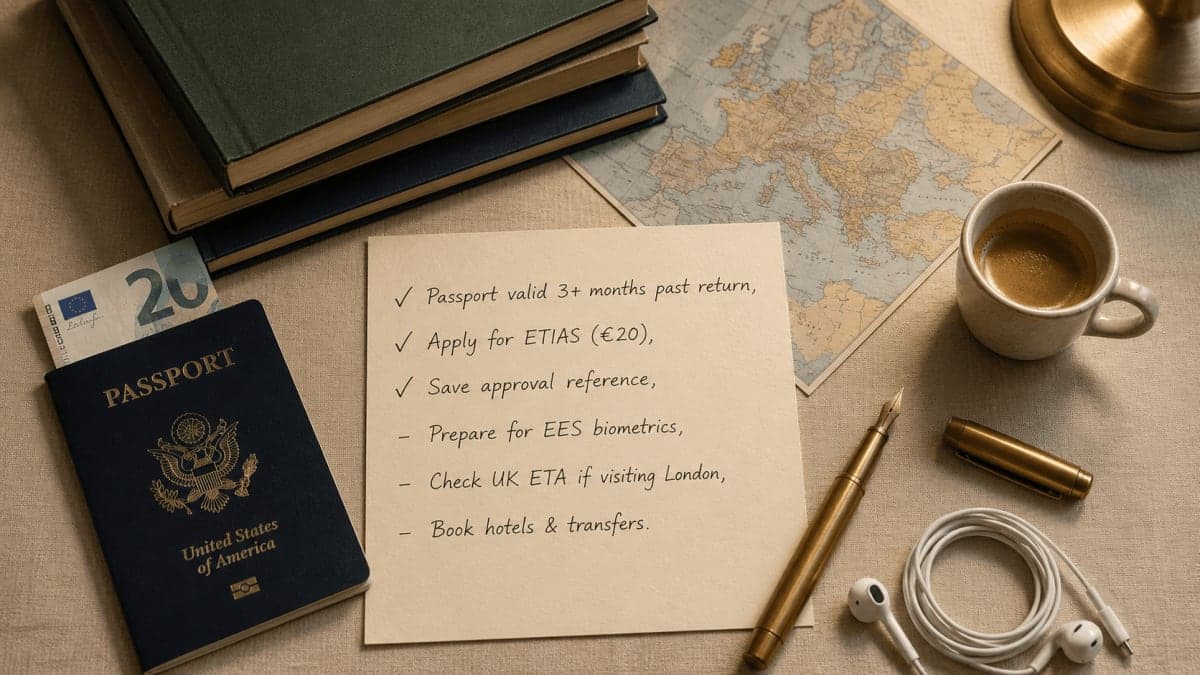
- Passport: Must be biometric and valid for at least 3 months beyond your planned departure from Europe.
- ETIAS fee: nothing to pay yet. Budget €20 (approx. $22–$24 USD) per person aged 18–70 for when the system launches.
- Reference Number: once ETIAS is running, save your approval and application number in a secure digital folder. There is nothing to save today.
- EES Check: Be prepared for a slightly longer first border crossing as your biometrics are registered.
- Verify before travel: Re-check the official ETIAS portal and your destination's State Department country page within a week of departure.
Plan an ETIAS-Ready Trip With Navoy
No authorization is needed today, and Navoy can help you plan inside the 30-country zone now. Use our destination hubs for Lisbon, Santorini, and Reykjavik as practical anchors for an ETIAS-ready trip. Navoy does not apply for ETIAS on your behalf.
FAQ: ETIAS for US Travelers
Why did the fee increase from €7 to €20?
The EU raised the ETIAS fee to €20 in 2026, up from the earlier €7 figure cited in pre-launch materials. Officials tie the change to inflation and the cost of linking ETIAS with the live Entry/Exit System (EES). Travelers under 18 and over 70 remain exempt. Budget the fee per passport holder aged 18–70 before you book non-refundable flights.
Do I need to apply for ETIAS every time I visit?
No. One approved ETIAS is valid for up to three years or until your passport expires, whichever comes first. You can enter and leave the 30 participating countries multiple times in that window if you respect the 90 days in any 180-day period Schengen rule. If you renew your US passport, you must apply for a new ETIAS linked to the new document.
Is there an official mobile app?
Yes. The European Union offers an official ETIAS app and the broader Travel to Europe app for mobile access to the same systems. Download only from official EU channels listed on travel-europe.europa.eu. Third-party expediter apps are not required and may charge unnecessary fees.
What if my ETIAS application is refused?
If your ETIAS is refused, you generally cannot board transport to participating countries until the issue is resolved. Per EU guidance, you may have a right to appeal or reapply depending on the reason code. A refusal is not the same as denied entry at the border, but carriers typically require valid authorization tied to your passport before departure. Check the message in your official application account and follow next steps only on the official ETIAS portal.
Related articles
- How to Plan Travel in 2026: A Guide for the Year of Global Events – planning context before you book Europe
- Coolcation 2026: Iceland vs Norway vs Scotland: Which Wins? – two ETIAS countries compared for summer 2026
- Personalized vs Generic Itinerary: Which Works Better? – how to structure a multi-stop European trip
Sources
- Official EU ETIAS portal - current operational status, the EUR 20 fee, validity, and the commitment to announce a start date several months in advance
- European Commission, Entry/Exit System - EES fully deployed 10 April 2026
All figures and the ETIAS status verified 7 September 2026 against the EU's own pages.
About the Author
Ranym Garali
Ranym is the Marketing and Content Lead at Navoy. She's been writing about travel for two years and digs into the data behind each piece, flight prices, visa rules and what people are actually searching for , so the advice holds up in practice.


