Key Takeaways
- Summer travel prices peak in July and August, when demand is highest and the cheapest inventory is already gone.
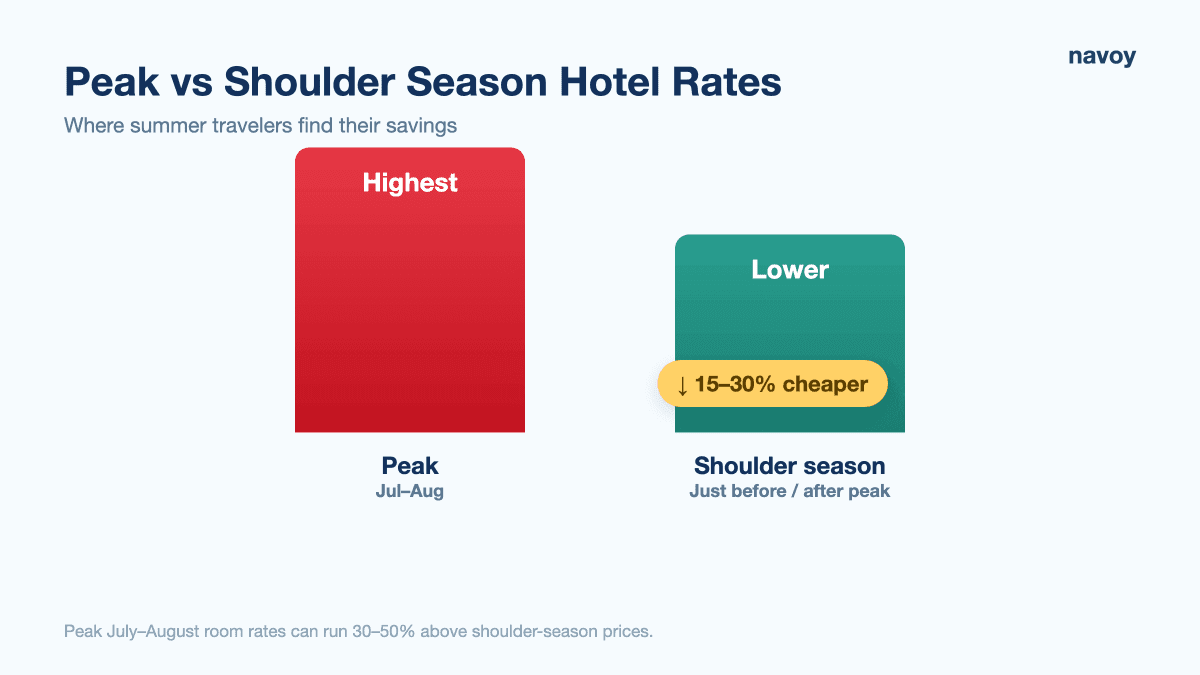
- Shoulder-season rates run about 15–30% cheaper than the August peak, so timing matters more than luck.
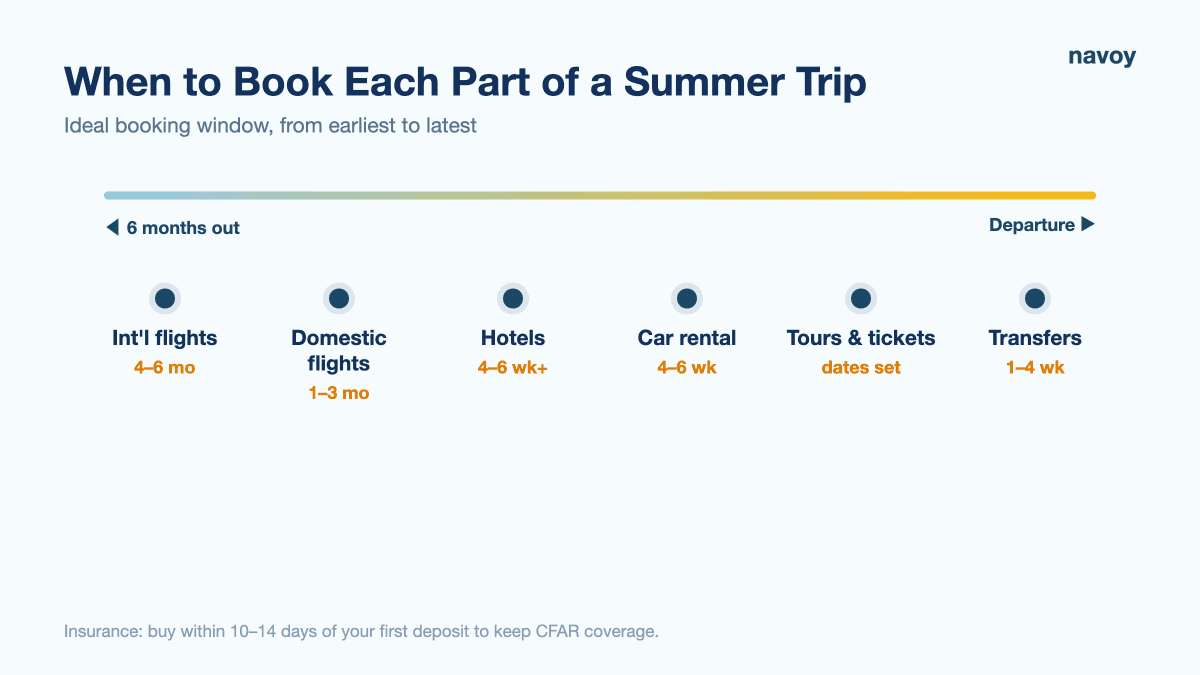
- Book flights 1–3 months ahead (domestic) or 4–6 months ahead (international); hotels and car rentals at least 4–6 weeks out.
- Buy travel insurance within 10–14 days of your first deposit to keep Cancel For Any Reason coverage.
- Navoy shows real-time pricing on hotels and airport transfers,
What Should You Book First Before Summer Prices Spike?
Book flights, hotels, and car rentals first — they carry the biggest summer price jumps and the tightest inventory. Then lock airport transfers, tours, timed-entry tickets, and travel insurance. Summer demand peaks in July and August, so the cheapest options sell out before prices climb, and shoulder-season rates run about 15–30% lower than the August peak.
The pattern repeats every year. As soon as schools break and the weather turns, millions of travelers book the same dates, the same beaches, and the same flights. Supply is fixed, demand spikes, and prices follow. The fix is not a secret coupon. It is booking the right things in the right order, early enough to catch lower rates and real availability.
Below are the 7 things to book before the surge, ranked by how much money early booking saves you, with the ideal booking window for each.
How Far Ahead Should You Book for Summer? (Booking Window)
For summer travel, book international flights 4–6 months ahead, domestic flights 1–3 months ahead, and hotels plus car rentals at least 4–6 weeks out. Tours and timed-entry tickets should be booked the moment your dates are set, because the most popular slots sell out weeks in advance.
| What to book | Ideal booking window (summer) | Why it matters |
|---|---|---|
| International flights | 4–6 months ahead | Long-haul fares climb earliest and fastest |
| Domestic flights | 1–3 months ahead | August averages ~29% cheaper than December fares |
| Hotels | 4–6 weeks+ (early discounts open Jan–Mar) | Peak July–Aug rates can rise 30–50% over shoulder season |
| Car rentals | 4–6 weeks ahead | Summer is the busiest, priciest rental season |
| Airport transfers | 1–4 weeks ahead | Fixed pre-booked price beats on-arrival surge fares |
| Tours & timed-entry tickets | As soon as dates are set | Popular slots sell out weeks to months ahead |
| Travel insurance | Within 10–14 days of first deposit | Keeps Cancel For Any Reason and waiver eligibility |
1. Flights — Lock In Before Fares Climb
Book summer flights early: 1–3 months ahead for domestic trips and 4–6 months ahead for international ones. Airfare is usually the single largest line item, so a small percentage saved here beats a big discount on anything else.
Within summer, August tends to be the cheapest month, with fares averaging about 29% lower than December, and early June and late August are the softest windows. If your dates flex, midweek departures on Tuesday or Wednesday can save roughly $56 per ticket versus weekend flights. Navoy does not book flights, but you can map your route and dates in your Navoy itinerary first, then book the fare with your airline once you have locked the cheaper days.
2. Hotels — Where the Summer Surge Hits Hardest
Book summer hotels at least 4–6 weeks out, and watch for early-booking discounts that open between January and March. Peak July and August room rates can run 30–50% above shoulder-season prices, and the best-value rooms in popular areas sell out first.
This is the line item where booking early pays off most, because hotel pricing moves with real-time demand. With Navoy, you search across 2.9M+ properties with live pricing, so you see the actual nightly rate today instead of discovering a higher one next week. If your dates have any give, shifting into the shoulder season around the August peak is where the 15–30% savings live — our Lisbon destination guide is a good example of a city where off-peak weeks cost noticeably less.
3. Car Rentals — The Sneaky Summer Spike
Reserve summer rental cars at least 4–6 weeks ahead. June through August is the busiest and priciest rental season, and demand surges hardest in coastal areas, national parks, and major cities, where fleets sell out and daily rates climb.
A useful tactic: lock a refundable reservation 4–6 weeks out to secure a car at a known price, then re-shop closer to the date in case rates drop. National average daily rates have hovered around $47, but remote tourist hubs can top $100 a day in summer. Booking late often means paying the surge rate or driving away in whatever is left on the lot.
4. Airport Transfers — Cheaper Pre-Booked Than On Arrival
Pre-book your airport transfer 1–4 weeks ahead so you pay a fixed, known price instead of an on-arrival surge fare. Peak-season arrivals are exactly when taxi queues are longest and rideshare surge pricing is highest, so settling this in advance removes both the cost spike and the post-flight stress.
With Navoy, you can add an airport or city transfer to the same trip as your hotel and see the price up front. Locking it early means one less thing to negotiate at midnight in an unfamiliar airport, and a rate that will not jump because you happened to land during a rush.
5. Tours & Experiences — They Sell Out and Reprice
Book marquee tours and experiences as soon as your dates are set, because the best ones sell out weeks to months ahead in summer. Walk-up rates are almost always higher than advance prices, and the most popular experiences sell out entirely, not just at a worse price.
Real examples make the point: London's Harry Potter Studio Tour often needs booking 3–4 months ahead or the moment tickets release; morning slots at Paris sights like Sainte-Chapelle and Musée d'Orsay regularly disappear in summer; and Hawaii's popular Haleakalā sunrise reservations can sell out within minutes. Slot these into your personalized itinerary early so the must-do experiences anchor your days.
6. Timed-Entry Tickets & Restaurant Reservations
Reserve timed-entry attraction tickets and sought-after restaurants the moment booking windows open. Major museums, landmarks, and theme parks now run timed entry, and the best morning slots in summer go fast — the Colosseum in Rome is a classic sell-out.
Restaurants work the same way. The tables you actually want, especially for groups, get claimed early in peak season. A five-minute reservation now saves you from a 90-minute wait or a closed door later. Build these around the experiences from the previous step so your day flows logically instead of zig-zagging across the city.
7. Travel Insurance — Buy Soon After You Book
Buy travel insurance within 10–14 days of your first trip deposit to keep time-sensitive benefits like Cancel For Any Reason (CFAR) and pre-existing-condition waivers. Wait too long and you can still get core coverage, but you lose access to those premium options.
CFAR typically reimburses 50–75% of your non-refundable costs if you need to cancel for a reason a standard policy would not cover. With more prepaid bookings stacked up before summer, that flexibility is worth locking in early. You can buy comprehensive coverage any time up to the day before departure, but the valuable upgrades depend on that early window.
Beat the Surge: What to Lock In First
If you can only act on a few things this week, start with flights, hotels, and car rentals — they move the most money and the most inventory. Everything else can follow once those three are secured.
| Priority | Book this | Surge risk if you wait |
|---|---|---|
| 1 | Flights | High — fares climb steadily into summer |
| 2 | Hotels | High — peak rates 30–50% over shoulder season |
| 3 | Car rentals | High — fleets sell out in tourist hubs |
| 4 | Airport transfers | Medium — surge fares on arrival |
| 5 | Tours & timed-entry tickets | High — sell out entirely, not just pricier |
| 6 | Restaurant reservations | Medium — best tables gone early |
| 7 | Travel insurance | Low cost, but CFAR window closes |
Plan and Book Hotels and Transfers in One Place With Navoy
Navoy is an AI travel platform that builds a day-by-day itinerary from a short description of your trip, then lets you book hotels and airport transfers in the same place. Founded in 2025 and based in San Francisco, it shows real-time pricing on 2.9M+ hotel properties, so you see today's rate before it rises and book without bouncing between fifty browser tabs.
For summer, that means you can sketch your dates, compare live hotel and transfer prices, and lock the bookings that surge hardest — all before peak demand pushes them up. You can start free at Navoy and upgrade to Pro ($12.99/month) for unlimited trips when you need it.
Frequently Asked Questions
When is the cheapest time to book summer travel?
Book international flights 4–6 months ahead and domestic flights 1–3 months ahead, with hotels and car rentals at least 4–6 weeks out. Within summer itself, August is usually the cheapest month to fly, and shoulder-season weeks around the July–August peak run about 15–30% cheaper for hotels.
How far in advance should I book a summer hotel?
Book summer hotels at least 4–6 weeks in advance, and earlier for popular destinations, since many chains open their best early-booking discounts between January and March. Peak July and August rates can sit 30–50% above shoulder-season prices, and the best-value rooms in busy areas sell out before the rates even peak.
Do summer travel prices really drop in shoulder season?
Yes. Shoulder-season weeks, the stretches just before and after the July–August peak, typically cost about 15–30% less for hotels, with thinner crowds at the same attractions. If your dates flex by even a week or two, shifting out of peak is one of the most reliable ways to cut a summer trip's cost.
Does Navoy book flights?
No. Navoy plans your trip and books hotels and airport transfers, but it does not book flights. You can map your route and dates inside your Navoy itinerary, then book the flight with your airline, and handle hotels and transfers with live pricing directly in Navoy.
Sources
- Going.com — When Is the Best Time to Book a Flight? (2026 Data)
- The Points Guy — The best time to book flights for cheap airfare in 2026
- NerdWallet — The Best Days to Book a Flight and When to Fly
- Expedia / Hotels.com — 2026 Hotel Price Index
- Hotel News Resource — Rising Hotel Prices Are Reshaping How Travelers Book Summer Trips
- Rentall Software — Car Rental Prices by City in 2026 + Seasonal Trends
- girlgonelondon — Attractions You MUST Book Ahead of Time in London (2026)
- Squaremouth — When Is the Best Time to Buy Travel Insurance?
- InsureMyTrip — Best Travel Insurance with Cancel for Any Reason (CFAR) 2026
Planning the rest of your trip? See our full 2026 trip-planning guide, why a personalized itinerary beats a generic one, and the ETIAS requirements for US travelers if Europe is on your list.
Ready to beat the summer price surge?
Plan and book your trip with Navoy →
Sketch your dates, compare live hotel and transfer prices, and lock the bookings that spike hardest before peak demand pushes them up.
About the Author
Ranym Garali
Ranym is the Marketing and Content Lead at Navoy. She's been writing about travel for two years and digs into the data behind each piece, flight prices, visa rules and what people are actually searching for , so the advice holds up in practice.