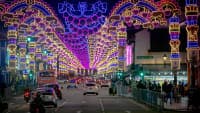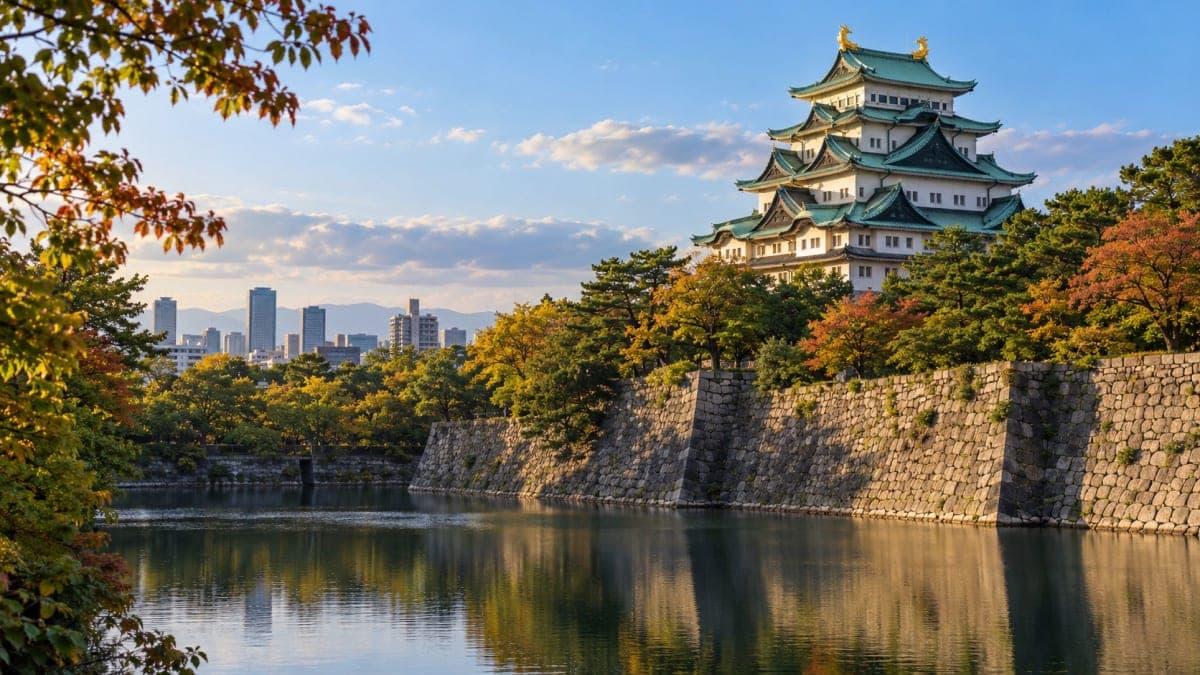
Key Takeaways
- The Result: China topped the medal table with 169 golds, host Japan set a national record with 83, and South Korea finished third with 39.
- The Weather: Typhoon Dujuan pushed equestrian eventing in Tokyo back a day, and heavy rain compressed rowing into two days and washed out all four men's cricket quarterfinals.
- What's Next: Doha, Qatar hosts the 21st Asian Games, awarded for 2030 and now planned for 2031 after an OCA board vote.
- Still Worth the Trip: Gifu City, 18 to 20 minutes from Nagoya by JR, remains the smart base for Aichi, Inuyama and the Nakasendo Trail.
Asian Games 2026 Japan: Results Recap and When the Next Games Are
Updated 23 October 2026 with the results and the next Games.
The 20th Asian Games ran in Aichi and Nagoya from 19 September to 4 October 2026, with the first matches played on 10 September. China topped the medal table with 169 golds, host Japan set a national record with 83, and South Korea finished third with 39. About 17,000 athletes and officials took part across 469 medal events, the first Asian Games in Japan since Hiroshima 1994 (Reuters via The Star, 4 Oct 2026). The next Games go to Doha, Qatar.
Below: the results, the typhoon and rain disruptions, what went wrong for visitors, and why Aichi and Gifu are still worth the trip now the crowds have gone.

When are the next Asian Games?
The next Asian Games are the 21st edition in Doha, Qatar. They were awarded for 2030, but on 15 February 2026 the Olympic Council of Asia (OCA) board voted to move the Asian Games to the year before each Olympics, which shifts Doha to 2031, pending agreement with Qatar. Doha won the hosting vote in December 2020, and Riyadh, Saudi Arabia, will host the 22nd Games in 2034 (OCA, 16 Dec 2020).
What we know about the date question:
- Why 2031 is on the table: the OCA is considering holding its flagship Games one year before each Summer Olympics so they can double as continental Olympic qualifiers. For Doha, that means 2031, months before the Brisbane 2032 Olympics (AFP via France 24, 1 Oct 2026).
- Where the idea stands: the OCA executive board unanimously accepted the new cycle on 15 February 2026 and told its management to bring Qatar and Saudi Arabia on board; under it Riyadh would also move from 2034 to 2035 (OCA board decisions, 15 Feb 2026). IOC President Kirsty Coventry has backed it (Reuters, 1 Oct 2026).
- What Doha says: Doha 2030 chief executive Ahmad Abdulla Al-Buenain told reporters in Nagoya on 1 October 2026: "For us, it's 2030", adding that organisers are ready if it moves and that the decision sits "between the OCA and the IOC".
- The handover: the OCA flag was passed to Qatar at the closing ceremony on 4 October 2026 (Aichi-Nagoya 2026).
No official dates for Doha have been published on an OCA or Doha organiser page we could check, for either year. If you are planning a trip around the Games, wait for the confirmed year and dates before booking anything non-refundable. Qatar has hosted before: Doha staged the 2006 Asian Games.
Planning Aichi now the crowds have gone? Compare Nagoya hotels with Gifu hotels, or plan the trip free with Navoy.
When and where were the Asian Games 2026?
The 20th Asian Games officially ran from 19 September to 4 October 2026, opening and closing at Nagoya City Mizuho Park Athletic Stadium (Paloma Mizuho Stadium), with early-round competition from 10 September. The first match was men's basketball at the Aichi International Arena, where Qatar beat Iran on 10 September (AFP via The Express Tribune, 10 Sep 2026). The Games were hosted by Aichi Prefecture and Nagoya City, with venues spread into Gifu, Tokyo and Shizuoka.
The anchors:
- First Japan host since 1994 (Hiroshima).
- About 17,000 athletes and officials, roughly 2,000 more than organisers had budgeted for (Reuters).
- 469 medal events in a record 43-sport programme, with padel, mixed martial arts, teqball and surfing making their Games debuts.
- 45 Asian countries and regions plus a Refugee Team paraded at the closing ceremony (Aichi-Nagoya 2026).
Asian Games 2026 final medal table: the top 3
| Rank | Team | Gold | Silver | Bronze | Total |
|---|---|---|---|---|---|
| 1 | China | 169 | 89 | 83 | 341 |
| 2 | Japan | 83 | 95 | 91 | 269 |
| 3 | South Korea | 39 | 43 | 68 | 150 |
Source: final standings reported by Xinhua via Global Times, 4 Oct 2026; China and Japan totals also reported by Reuters. Live standings: official results site.
China topped the gold table for the 12th Games in a row, and its 341 medals were its best haul at an Asian Games held outside China. Japan's 83 golds were its most at any Asian Games, beating the 78 it won at Bangkok 1966 (JOC results archive).
What were the standout moments of the Asian Games 2026?
The Games belonged to teenagers: a 13-year-old Chinese swimmer was named MVP, and a 17-year-old Japanese swimmer broke a world record.
- Yu Zidi (China, 13, swimming): won the women's 200m butterfly, 200m individual medley and 400m individual medley, and became the youngest MVP in Games history (Aichi-Nagoya 2026).
- Puripol Boonson (Thailand, 20, athletics): won the men's 100m in 9.90 seconds and the 200m in 19.88, equalling the Asian record, and was named men's MVP (Aichi-Nagoya 2026).
- Shin Ohashi (Japan, 17, swimming): broke the men's 200m breaststroke world record (Reuters).
- Zhang Zhanshuo (China, 19, swimming): became the first swimmer to win seven golds at the Games (Reuters).
- Men's football final: South Korea beat Japan 1-0 in front of about 30,000 fans (AFP via The Express Tribune, 4 Oct 2026).
Did a typhoon affect the Asian Games 2026? (台風の影響は?)
Yes, but only in a few sports. Typhoon Dujuan pushed equestrian eventing in Tokyo back in the first week, and heavy rain later compressed rowing into two days and washed out all four men's cricket quarterfinals. Most competitions ran as scheduled.
What happened, in order:
- Before the opening: torrential rain hit Nagoya and the surrounding region, closing schools, suspending train services and forcing several hundred athletes to evacuate their accommodation (Reuters via The Star, 17 Sep 2026).
- 21 September, Typhoon Dujuan: organisers postponed the start of equestrian eventing at the Tokyo Equestrian Park from Monday 21 to Tuesday 22 September as a precaution, and a later revision moved the cross-country phase to 23 September (Aichi-Nagoya 2026) (New Straits Times, 21 Sep 2026).
- Rowing: after storms and heavy rain, the originally planned five-day regatta was squeezed into heats on 23 September and finals on 24 September (VOV, 23 Sep 2026). The course, the Nagaragawa International Regatta Course, straddles Kaizu in Gifu and Aisai in Aichi (Aichi-Nagoya 2026 venues).
- Late September rain: persistent rain disrupted tennis, surfing and cricket. All four men's cricket quarterfinals were washed out on 28 and 29 September, and India, Pakistan, Sri Lanka and Bangladesh advanced on ranking (Al Jazeera, 28 Sep 2026; Reuters via The Star, 29 Sep 2026).
If you held a ticket for a cancelled session: organisers say refunds for sessions cancelled for operational reasons or severe weather start in bulk from November 2026, after the Asian Para Games. Keep your e-ticket and confirmation email; tickets bought from unauthorised resellers are not eligible (Aichi-Nagoya 2026, 20 Oct 2026).
What went wrong for visitors?
No athletes' village, too few beds, late buses and empty seats: the frugal model saved money but frustrated teams and kept many fans away. Organisers housed competitors in hotels, temporary wooden units and a cruise ship instead of building a village, and a late influx of about 2,000 extra athletes and officials stretched rooms and transport (Al Jazeera).
Crowds were thin at many venues. Fewer than 1,000 spectators watched Japan play South Korea in the women's football semi-final in a 50,000-capacity stadium, and smaller venues in remote locations were often nearly empty (Reuters).
The travel lesson for future multi-sport events in Japan: the venue spread, not the host city name, decides how hard your trip is.
What was the "Geography Trap" at the Nagoya Asian Games?
The "Geography Trap" was the gap between the "Aichi-Nagoya" branding and reality: high-profile sports like Swimming and Equestrian were held in Tokyo, up to 350 km from Nagoya. Organisers cut costs by reusing venues from the Tokyo 2020 Olympics. Fans who booked a Nagoya hotel assuming everything was local found themselves hours away from their event.
The "Exiles": sports held outside Aichi
| Sport | Venue | Location | Distance from Nagoya |
|---|---|---|---|
| Swimming | Tokyo Aquatics Centre | Tokyo | 350 km (1.5 to 2 hrs Shinkansen) |
| Equestrian | Tokyo Equestrian Park (Baji Koen) | Setagaya, Tokyo | 350 km (1.5 to 2 hrs Shinkansen) |
| Track Cycling | Izu Velodrome | Izu, Shizuoka | 200 km (2.5+ hrs transit) |
| Artistic Swimming | "ToBiO" Furuhashi Hironoshin Memorial Hamamatsu Swimming Center | Hamamatsu, Shizuoka | 100 km (45 min Shinkansen) |
| Rowing | Nagaragawa International Regatta Course | Kaizu, Gifu / Aisai, Aichi | Close to Nagoya |
Sources: Aichi-Nagoya 2026 venues; FEI Equestrian.
The rule still holds for any event in Japan: match your hotel to your venue, not to the name of the event.
The Asian Para Games 2026: 18 to 24 October
The 5th Asian Para Games opened on 18 October 2026 at Nagoya City Mizuho Park Athletic Stadium and ran until 24 October, with nearly 3,000 athletes from 45 countries and regions competing in 18 sports (CGTN, 19 Oct 2026).
The Commuter Ring: why Gifu City is still the smart Nagoya base
Gifu City is 18 to 20 minutes from Nagoya Station on the JR Tokaido Line, usually cheaper than central Nagoya, and has a historic castle-town atmosphere that beats sleeping next to a major station. The Games are over, but the logic holds for anyone exploring the Chubu region, and Gifu even shared the Games: the rowing course sits on the Nagara River at Kaizu.
What you get:
- Commute: 18 to 20 min via the JR Central Tokaido Line Rapid service.
- Cost: generally cheaper than Nagoya Station hotels, especially when a big event fills the city.
- Bonus: Gifu Castle, the Nagara River cormorant fishing tradition, and a quiet evening pace.
- Gateway: direct access to the scenic Nakasendo Trail towards Magome and Tsumago.
If Gifu fills up, Toyohashi (east, 30 min by Shinkansen) and Yokkaichi / Tsu in Mie Prefecture (south, 30 to 50 min) are the next rings out.
What are the best "Hidden Aichi" things to do now the Games are over?
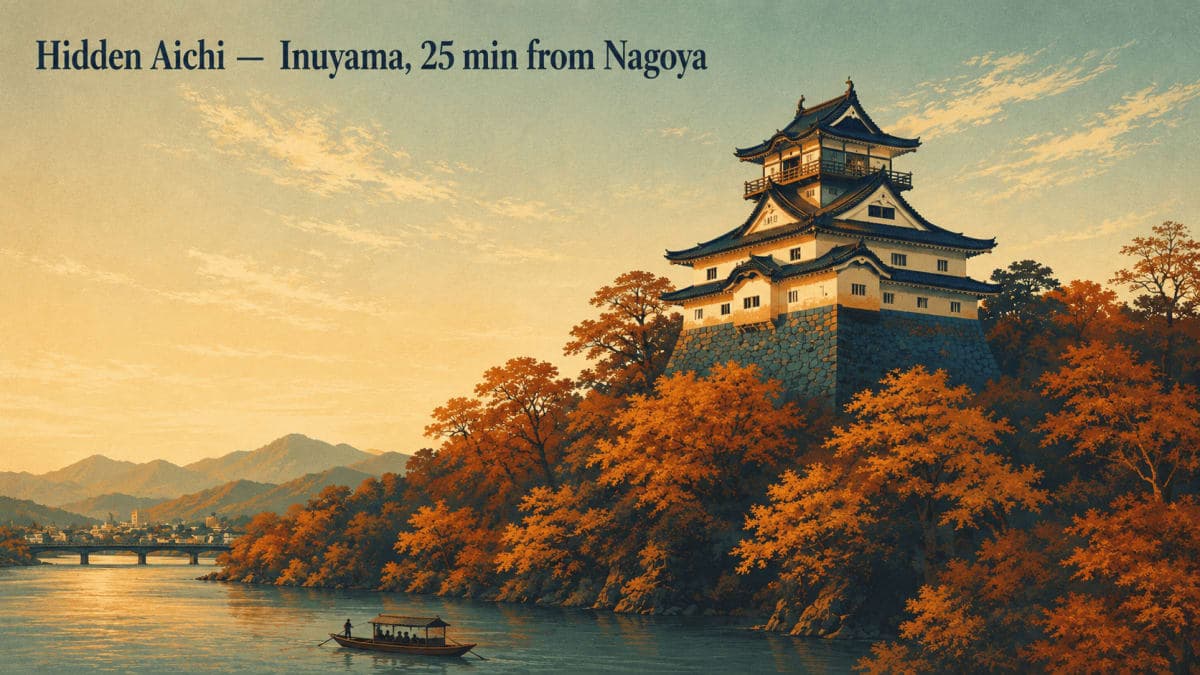
With the Games crowds gone, the Chubu region is back to being one of Japan's most underrated stops: Inuyama Castle, the Nakasendo Trail and Nagoya's distinctive food culture all sit within an easy day from the city. Most Western itineraries park in Kyoto for three nights and never see this part of Japan.
Inuyama: the "Little Kyoto" 25 minutes from Nagoya
Inuyama Castle is one of only five remaining original castles in Japan (a National Treasure). The surrounding town has Edo-period streets, river-cruise cormorant fishing in summer, and a fraction of Kyoto's foot traffic.
Nagoya meshi: a food culture you only get here
- Hitsumabushi: grilled eel served over rice, eaten in three stages: plain, with condiments, then with dashi poured over.
- Morning Service: the local coffee-shop ritual (perfected by chains like Komeda's Coffee) where ordering a coffee comes with a free breakfast of toast and a hard-boiled egg.
- Tebasaki: peppery fried chicken wings; the Sekai no Yamachan vs. Furaibo debate is Nagoya's "Coke vs. Pepsi."
The Nakasendo Trail
A preserved Edo-period post-road between Magome and Tsumago. The 8 km walk through cedar forest and old post towns is one of the most atmospheric day trips in Japan, and it is two hours from Nagoya.
Practical tips for an Aichi and Gifu trip
The 2026 Games showed the two things that catch visitors out in Central Japan in autumn: venue spread and weather. Plan for both and the region is easy.
- JR Pass economics: after the October 2023 price rise (+69%), the National JR Pass is rarely worth it for a Nagoya-centred trip. The JR Takayama-Hokuriku Area Tourist Pass often beats it for the Aichi, Gifu and Kanazawa loop.
- Typhoon Plan B: late September is peak typhoon season, as Typhoon Dujuan showed in 2026. Nagoya has extensive underground arcades (Sakae, Meieki) and the SCMAGLEV and Railway Park as indoor backups.
- Big-event weeks: when a major event comes to Nagoya, base yourself in Gifu or Toyohashi and commute in.
- Asian Games ticket refunds: if a session you bought was cancelled, follow the official refund notice; bulk refunds start from November 2026.
FAQ
When are the next Asian Games?
The next Asian Games are the 21st edition in Doha, Qatar. They were awarded for 2030, but the Olympic Council of Asia board voted on 15 February 2026 to hold the Games the year before each Summer Olympics, which moves Doha to 2031 and Riyadh's 22nd Games from 2034 to 2035, pending agreement with the hosts. Doha's organisers said in October 2026 they are ready for either year.
When were the Asian Games 2026 held?
The 20th Asian Games officially ran from 19 September to 4 October 2026 in Aichi Prefecture and Nagoya, Japan. The first matches were played on 10 September, nine days before the opening ceremony at Nagoya City Mizuho Park Athletic Stadium.
Who won the most medals at the Asian Games 2026?
China topped the medal table with 169 gold, 89 silver and 83 bronze (341 in total). Host Japan was second with 83 gold and 269 medals, its best ever haul, and South Korea was third with 39 gold and 150 medals.
Did a typhoon affect the Asian Games 2026?
Yes, in a few sports. Typhoon Dujuan caused organisers to postpone the start of equestrian eventing in Tokyo from 21 to 22 September. Storms and heavy rain also compressed the rowing regatta into two days (23 and 24 September) and washed out all four men's cricket quarterfinals. Most competitions were unaffected.
When were the Asian Para Games 2026?
The 5th Asian Para Games ran from 18 to 24 October 2026 in Aichi and Nagoya, with nearly 3,000 athletes from 45 countries and regions in 18 sports.
Is Nagoya worth visiting after the Asian Games?
Yes. The crowds and Games-week hotel pressure are gone, and the region's draws are unchanged: Inuyama Castle, the Nakasendo Trail between Magome and Tsumago, Gifu's castle town, and Nagoya's food culture. Gifu City, 18 to 20 minutes away by JR, remains a good base.
Sources
- Reuters via The Star, 4 Oct 2026
- OCA, 16 Dec 2020
- AFP via France 24, 1 Oct 2026
- OCA board decisions, 15 Feb 2026
- Reuters, 1 Oct 2026
- Aichi-Nagoya 2026
- AFP via The Express Tribune, 10 Sep 2026
- Aichi Prefecture and Nagoya City
- Xinhua via Global Times, 4 Oct 2026
- official results site
- JOC results archive
- Aichi-Nagoya 2026
- AFP via The Express Tribune, 4 Oct 2026
- Reuters via The Star, 17 Sep 2026
- Aichi-Nagoya 2026
- New Straits Times, 21 Sep 2026
- VOV, 23 Sep 2026
- Aichi-Nagoya 2026 venues
- Al Jazeera, 28 Sep 2026
- Reuters via The Star, 29 Sep 2026
- Aichi-Nagoya 2026, 20 Oct 2026
- Tokyo 2020 Olympics
- Tokyo Aquatics Centre
- Izu Velodrome
- FEI Equestrian
- CGTN, 19 Oct 2026
- JR Central Tokaido Line
- Nakasendo Trail
- Inuyama Castle
- JR Takayama-Hokuriku Area Tourist Pass
- SCMAGLEV and Railway Park
The Bottom Line
The 2026 Asian Games are done: China won the table, Japan had its best Games ever, and the next edition belongs to Doha, now planned for 2031. The lessons for travellers outlast the event: in Japan, match your hotel to your venue, keep a rainy-day plan in typhoon season, and look one stop beyond the big city. Aichi and Gifu are still there, and quieter than they were in September.
Related reading:
- What is a personalised travel itinerary?: the pillar guide on planning around fixed events
- How expensive are World Cup tickets in 2026?: the other big 2026 event-travel story
- Coolcation 2026: Iceland vs Norway vs Scotland: the calm-summer trend
Plan your Aichi and Gifu trip with Navoy. It is free to plan a trip at navoy.io. Get started
- Hotels in Nagoya: compare live prices
- Hotels in Gifu: compare live prices
- Airport transfers in Tokyo and Osaka: book a ride if you fly in there and take the Shinkansen to Nagoya
About the Author
Ranym Garali
Ranym is the Marketing and Content Lead at Navoy. She's been writing about travel for two years and digs into the data behind each piece, flight prices, visa rules and what people are actually searching for , so the advice holds up in practice.